Packing a suitcase for China these days is easy — but planning a payment strategy is something you'd better prepare for in advance. China has practically abandoned cash: most purchases, rides, and even street food are paid via QR codes through Alipay or WeChat Pay. For Russians the situation has become even more complicated because of sanctions: Visa cards from Russian banks don't work in China, and UnionPay's capabilities have shrunk significantly. So before your trip it's worth figuring out in advance which payment methods actually work in China for your specific situation. Besides my own experience, I also analyzed hundreds of reviews across various platforms, in themed Telegram chats, and among real travelers. This article isn't just theory — it's practice-tested recommendations that will help you pay for purchases, transport, hotels, and other expenses in China without a hitch.
1. A Foreign Visa Card + Alipay — the Most Reliable and Convenient Option
The most balanced method, according to reviews from experienced travelers, is to open a Visa card at a foreign bank (if you're Russian — for example, a Kazakh, Armenian, Kyrgyz, or Uzbek bank. Such a card isn't tied to Russian sanctions risk and works great in China) and link it to Alipay. Important: in practice, it's preferable to use a Visa card for Alipay. According to many foreign travelers' reviews, Visa usually works more reliably, while Mastercard sometimes has issues: the card links successfully, but individual payments may fail for no obvious reason. So if you're choosing a foreign card for your China trip, go with Visa. With it you can both withdraw cash yuan and pay via Alipay by QR code. Let's break down both options.
1.1. How to Withdraw Cash Yuan
A foreign Visa is accepted at ATMs with the Visa/Plus logo — that's almost every Bank of China, ICBC, and China Construction Bank machine. According to reviews:
— Stable acceptance, notes of 100 yuan.
— The fee depends on your issuing bank.
— Limits: typically the equivalent of 2,000–5,000 yuan per day; a larger amount can be withdrawn over several transactions.
— Conversion usually runs at the Visa payment system's rate, subject to your bank's terms.
1.2. Paying via AliPay with a Linked Foreign Visa
This is where the real convenience lies. China is a country of QR codes — cash is accepted less and less. AliPay solves this problem.
What you need to do:
1. Download the AliPay app (international version).
2. Register with Alipay: enter your passport details and phone number (a foreign one is fine, doesn't have to be Chinese).
3. Be sure to complete full identity verification: upload a passport photo, a selfie, and possibly proof of address.
4. Confirm Alipay is working: open the app, log in. If the interface is in Chinese, tap «Me» (the figure in the bottom-right corner) → «Settings» (the gear icon) → «General» → «Language» and choose English.
5. Link your foreign bank's Visa card: tap «Me» (the figure in the bottom-right corner) → «Bank Cards» → «General» → «Add Bank Card Language» and add your foreign bank card.
6. Important: it's preferable to link a Visa card specifically — payments through Alipay will be more reliable with it.
7. After verification (usually 1–3 days), your account becomes a fully functional payment tool.
8. Where the money comes from: when you open the QR code for payment (Pay/Collect on the home screen), the current funding source — a linked bank card or Balance — is shown under the QR code.
9. Important: foreign users should select a bank card as the payment method, not Balance. Funds will be debited directly from the linked card.
Reviews are unanimous: a linked Visa card works everywhere. You pay by scanning the QR code at the register, or by generating a code for the cashier. The charge is made from the card in yuan, with no hidden markups. Even street fruit vendors and taxis accept AliPay. The key is a stable mobile internet connection.
A nuance: AliPay may occasionally ask for extra verification on large amounts, but that's rare. Always keep a backup — the physical card itself and a little cash.
2. Cash Yuan: a Universal Backup Option
If you want a backup payment method, it's worth bringing cash yuan bought in your own country. Here are its main advantages:
— No technical surprises.
— You control the rate. It's most profitable to buy yuan before your trip at large banks or reputable exchange offices.
— Dollars as a backup. In China, dollars can be exchanged at Bank of China branches (a passport is required), though you shouldn't count on a fast exchange. The process takes longer than in many other countries: a bank employee checks the client's details, prepares documents, and may ask for your address in China and phone number. Depending on how busy the branch is, the whole process can take anywhere from 20–30 minutes to an hour or more. So it's best to treat dollars as a backup rather than your main way of getting yuan.
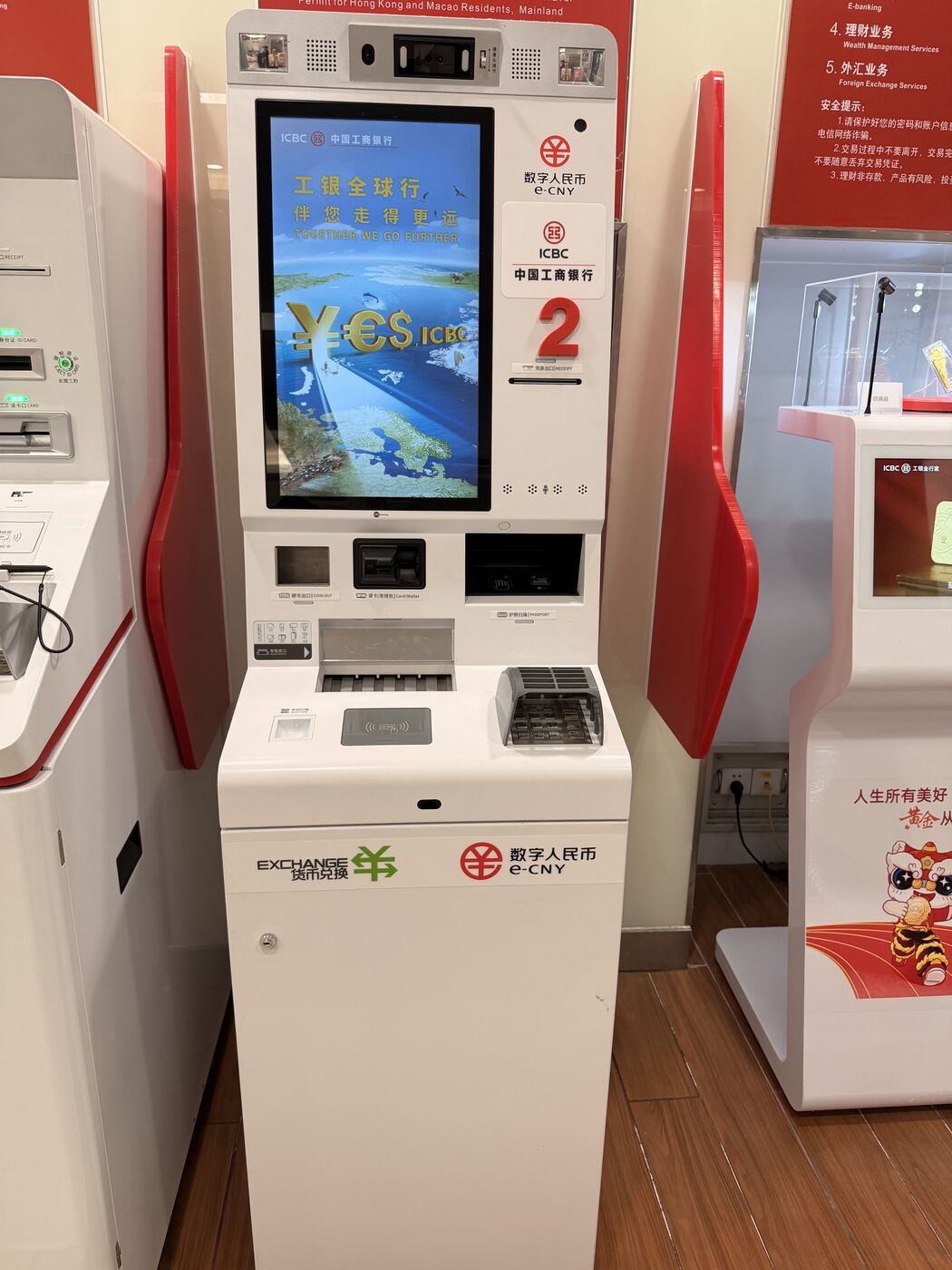
— Currency exchange machines (自助兑换机). A very convenient alternative. In major cities, some ICBC (Industrial and Commercial Bank of China/中国工商银行) branches have self-service machines (see photo below) that let you exchange cash US dollars and euros for yuan. You'll need a passport, and the process itself usually takes just a few minutes and is faster than going through a teller. If there's no machine at the nearest branch, show a staff member the sign «自助兑换机» or a photo of it — they'll be able to point you to the nearest branch that has one.
3. Russian UnionPay in China: a Lottery You'd Better Not Play
Many still think that a UnionPay card from a Russian bank is a ready-made pass into the world of Chinese payments. Unfortunately, reality is sobering.
3.1. Which Cards Can Even Work?
Only ones issued by banks not under blocking US/EU sanctions. After sanctions in late 2023 – early 2024 shut down foreign servicing for cards from Sber, VTB, Gazprombank, Tinkoff, Alfa-Bank, Rosselkhozbank, and dozens of others, UnionPay International disabled them worldwide. In China, terminals simply display "Transaction declined". Even if you have yuan on the account, it won't help — the block is at the issuing bank level.
As of mid-2026, only a handful remain "alive": Primsotsbank, Svoy Bank, Asia-Pacific Bank (APB), and possibly a couple more small regional ones. But even for them the situation is volatile — anyone could fall under sanctions tomorrow.
3.2. What Reviews Say About Working UnionPay
If your card is on the "green" list, then:
— Paying in shops: at large supermarkets, hotels, and chain restaurants, chip-and-PIN payments go through reliably. Contactless doesn't always work, so always carry the physical card.
— Linking to AliPay / WeChat: the dream of paying by smartphone runs into harsh reality. You can somehow link the card to the international version of AliPay, but 8 times out of 10 the payment attempt fails. Tencent and Ant Group detect the issuing country and automatically block "suspicious" transactions.
— Cash withdrawal: possible at ICBC and Bank of China ATMs, but takes patience. Chinese ATMs expect a 6-digit PIN, while Russian cards use 4 digits. Sometimes just pressing "Enter" after four digits works, sometimes it doesn't.
Bottom line: Russian UnionPay in 2026 is a backup option with a pile of caveats. You can't rely on it as your main tool.
4. Transfers to AliPay via T-Bank: Myths and Forum Reality
T-Bank announced the ability to top up an AliPay wallet directly from its app. Let's look at what real users say about it on forums.
As Advertised
You enter an amount in rubles, see the conversion to yuan at the bank's internal rate, and send a transfer to your own AliPay account (by phone number). Funds are credited in yuan, and you can pay by QR code right away.
What Real Reviews Say
— It works, but with nuances. Transfers go through after full AliPay verification. If verification isn't complete, the money can be stuck for an indefinite period.
— The ruble/yuan rate is set by T-Bank itself, and it's usually worse than the market rate. Reviews mention the phrase "predatory spread", but when there's no other option, people use it anyway.
— Fee: sometimes 0%, sometimes a "cross-border transfer" fee of about 1–2% appears. Forums advise checking the final amount before confirming. Pro-subscription clients can send up to 50,000 rubles a month with no fee. Above the limit, there's a 1% fee on the amount over the limit.
— Speed: from a few minutes to two days. Sometimes a payment goes to manual compliance review — nerve-wracking if you need the money urgently.
— Limits: no more than 30 transactions a day. Minimum/maximum amount per transaction in rubles — 4,500/220,000 rubles.
Some reviews mention that Alipay simply blocked a user after several successful transfers from T-Bank.
Forum summary: not the most reliable method. If you don't want to bother with a foreign card and are willing to accept losses on the exchange rate and occasional glitches, it's an acceptable option. Relying on it entirely, however, is risky.
Comparison Table: What to Choose?
| Payment method | Who it suits | Reliability | Exchange rate value | Features and limitations |
|---|---|---|---|---|
| Alipay + a foreign bank's Visa card | Most foreign tourists, Russians with a foreign Visa | ★★★★★ | Excellent (Visa + bank rate) | The most convenient option for everyday payments. Requires linking a card and Alipay verification. Per reviews, Visa is more reliable than Mastercard. You can also withdraw cash at any bank in China with the card. |
| Cash yuan (bought in advance) | All travelers | ★★★★★ | Very good (if bought at a favorable rate) | A reliable backup payment method, useful if you run into card or Alipay issues. |
| Cash dollars/euros to exchange in China | All travelers | ★★★★☆ | Average | A backup option. Exchanging at banks takes time and requires a passport and paperwork. |
| T-Bank → Alipay transfer | Mostly Russians | ★★★☆☆ | Mediocre (fees and conversion) | Suits as an additional method. Limits, crediting delays, service outages, and changing terms. |
| Russian UnionPay (non-sanctioned bank) | Russians | ★☆☆☆☆ | Good (when it works) | In practice unstable: may not be accepted by Alipay, and payment/withdrawal issues are possible. Not recommended as your main method. |
5. The Bottom Line: a Step-by-Step Plan for Your China Trip
From analysis to action. Based on real experience, here's your personal checklist for before and during the trip.
Before Departure (2–4 Weeks Out)
— 1. Open a foreign Visa card. If you already have a Visa from a foreign bank, just confirm it works abroad and check your cash withdrawal limits. If you don't have one (as is the case for many Russians), you can open one at a bank in another country (Kazakhstan, Armenia, Kyrgyzstan, etc.) yourself or through an intermediary.
— 2. Register and verify AliPay and link your foreign Visa card there — the most convenient option for payments in China. Download the international version, register with your passport, take a selfie, upload a passport photo. Link your foreign Visa card. Wait 1–3 days and check that the account is active (a verification indicator appears in your profile). Done! Now, with Alipay, you can freely pay for everything — from the metro and street food to purchases at malls. Fast, safe, and a great exchange rate. Carry the card itself as a physical backup for ATMs, in case you need more cash.
— 3. Buy cash yuan in your own country. This is your safety cushion. Choose a bank or exchange office with a reasonable rate. Once in China, break your 100-yuan notes into 10s, 20s, and 50s at a supermarket.
— 4. Check your Russian UnionPay (if you have a non-sanctioned one). If you have a Primsotsbank, Svoy Bank, or APB card, bring it on the trip, but treat it strictly as an emergency reserve. Put a token amount on it (yuan, not rubles). Don't make it your primary payment tool.
Planning a trip to China — for a trade fair or for sourcing? I help with finding suppliers, verifying counterparties, and organizing the route. Write to me — we'll work through your situation.
Planning a trip to China or sourcing from Chinese suppliers?
Contact Me